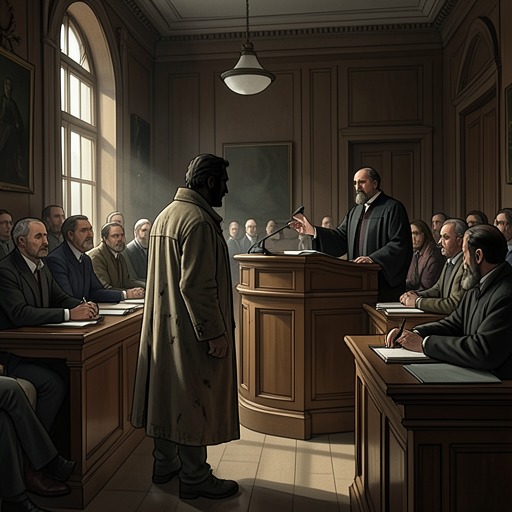
David Copperfield’s exploitation at Murdstone and Grinby’s
David CopperfieldDavid Copperfield’s exploitation at Murdstone and Grinby’s is the forced beginning of his working life, imposed when he is only ten and still dependent on adults for education and care. The warehouse work takes the place of schooling and the future he had hoped to build, while poverty and his association with the indebted Mr. Micawber expose him to hardships far beyond his years. In retrospect, David remembers this period as a painful break in his life: it ends when he escapes to Betsey Trotwood, but its emotional effects follow him into his return to school.
From domestic discipline to child labor
Before David is sent to the warehouse, his education at home has already been turned into a source of distress. Lessons that once began with his mother’s gentler teaching become long and difficult under the influence of Mr. Murdstone and Miss Murdstone, who use them to enforce their idea of firmness. David recalls that his mother nominally presided over the lessons while the Murdstones directed them; when she tried to prompt him, Miss Murdstone checked her, and Mr. Murdstone punished David and removed him from the room. Even a problem involving thousands of cheeses becomes another ordeal, leaving him unable to make progress and ashamed of his failure. These details establish that the warehouse is not an isolated disruption: his access to learning and support has already been constrained by adult authority.
David is eventually sent away to Salem House during a holiday, as punishment for his misdoing. The school is empty of its usual pupils, and its proprietor, Mr. Creakle, is away. David’s later account of being slighted, taught nothing, and put to work describes the cumulative result of this treatment and neglect. After his mother dies, the Murdstones send him into employment rather than restoring him to education or finding him a protective home. In his adult recollection, the striking fact is not simply that he has to work, but that no one intervenes on behalf of a perceptive and vulnerable child before he is made to earn his living.
Work in the warehouse
At ten, David becomes a laborer in Murdstone and Grinby's warehouse in Blackfriars, near the Thames. The business supplies wine and spirits to packet ships, and its work includes inspecting, rinsing, and washing empty bottles, as well as labeling full ones, fitting corks, sealing bottles, and packing them into casks. David performs this work alongside a small number of other boys. His working place is in a corner where Mr. Quinion can watch him from the counting-house, a detail that makes the arrangement both supervised and marginal: David is present as a worker, not as a pupil being prepared for a future profession.
The labor carries a private cost that David’s later narration places alongside its practical demands. He compares his new companions with the boys he had known earlier, including Steerforth and Traddles, and fears that his hope of becoming a learned and distinguished man has been crushed. He mourns the prospect that what he had learned and enjoyed will gradually disappear from his life. During the first morning, he weeps while washing bottles, feeling that his own sense of hope is breaking. The contrast is central to the episode: the work provides no path toward his childhood ambition, while its daily repetition threatens to erase the education and imaginative life that ambition depended on.
Poverty and the Micawber household
David’s time in London also brings him into the household of Mr. Micawber and Mrs. Micawber, where he encounters debt as a continuing condition of family life. Mrs. Micawber explains that creditors cannot obtain payment when her husband has no money to give, while creditors repeatedly come to the house. David helps the family by selling its possessions, including Mr. Micawber’s books, and by dealing with pawnbrokers. These responsibilities deepen his exposure to adult financial distress while he remains a child earning his living at the warehouse.
Mr. Micawber is eventually arrested for debt and taken to King's Bench Prison. David visits him there, shares a meal, and receives advice about keeping expenditure below income; Mr. Micawber then borrows a shilling from him for porter. The scene combines affection and material scarcity: David is a child visitor, but he is also a source of a small loan to the adult whose troubles he has witnessed. Mr. Micawber is later ordered discharged under the Act, to David’s relief, although formalities delay his release. Mrs. Micawber reports that the creditors are not wholly vindictive and that even a boot-maker accepts that a debt should be paid when money is owed. The household’s crisis does not itself constitute David’s employment, but it forms part of the precarious London life he must navigate while working.
Flight and the end of the period
When the Micawbers leave London, Mrs. Micawber briefly treats David with maternal warmth before he returns to his own weary work. He has already resolved not to remain at Murdstone and Grinby's: he will run away to the only relation he believes he has, Betsey Trotwood, and tell her what has happened. His decision grows in part from a remembered story about his birth and his mother’s account of Betsey’s visit. David cannot be certain that the faintly kind gesture his mother remembered had any real significance, but he turns it into a small reason to hope that his aunt might help him.
David reaches Betsey Trotwood after being robbed and walking the whole way. He tells her that he has been unhappy since his mother’s death, has been put to work unsuitable for him, and has not slept in a bed during the journey. His self-control gives way as he tries to show her his ragged state. Betsey takes him inside and cares for him, bringing the immediate flight to an end. The episode marks a change from being sent and employed by others to taking desperate action on his own behalf, although his escape depends on finding an adult willing to receive him.
Memory and lasting effects
Once Betsey has accepted him, David begins a new life under the name Trotwood Copperfield. Looking back, he describes the old life at Blunderstone as distant and the warehouse period as a curtain that has fallen. He says that he does not know whether his time at Murdstone and Grinby's lasted a year, more, or less; he knows only that it existed and then ceased. His refusal to examine its duration closely conveys how painful the memory remains, even in a narrative that has returned to it.
The effects of the period are also visible when David enters Doctor Strong's school. He feels separated from boys his own age by experiences they cannot know, and the work and hardship have left him awkward in their games and behind in his book-learning. He is placed in the lowest form and fears his schoolfellows will discover his familiarity with poverty, pawnshops, and the King's Bench Prison. Thus escape ends the employment but does not immediately restore an ordinary childhood: David carries the warehouse years into the classroom as shame, educational disadvantage, and a sense that he has lived outside the experience of other children.